
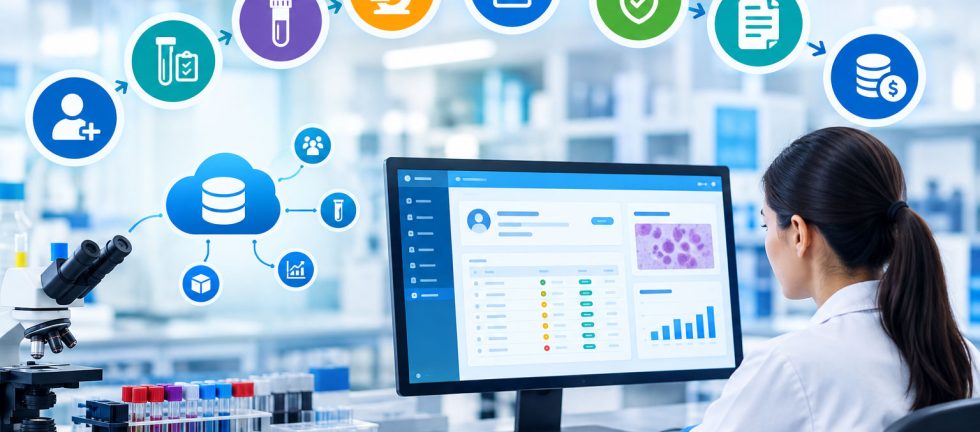
Laboratories are becoming increasingly dependent on technology to manage growing workloads, patient information, test results, samples, inventory, reporting, and administrative operations. As the number of tests and patients increases, managing these activities manually can become time-consuming and difficult to maintain.
This is where a Lab Management System can make a significant difference.
A modern Lab Management System provides laboratories with a centralized digital environment for managing their daily operations. Instead of depending on paper records, spreadsheets, and disconnected processes, laboratory staff can manage patient information, test orders, samples, results, reports, inventory, billing, and other activities through a connected system.
For medical laboratories, diagnostic centers, hospitals, research laboratories, and other testing facilities, laboratory management software is becoming an important part of digital transformation.
But what exactly is a Lab Management System, how does it work, and why are laboratories moving toward digital laboratory management?
Let’s explore it in detail.
What Is a Lab Management System?
A Lab Management System (LMS) is a software solution designed to organize, automate, and manage the day-to-day activities of a laboratory.
At a basic level, it connects different stages of the laboratory workflow. A patient may first be registered, followed by a test order, sample collection, laboratory testing, result entry, verification, and report generation. Instead of maintaining information separately at each stage, a laboratory management system can connect these activities within one digital platform.
This means information entered during registration can be used throughout the testing and reporting process.
For example, when a patient visits a diagnostic laboratory, the receptionist can register the patient and create a test order. The laboratory staff can then access the order, record the sample, enter the test results, and generate the final report without repeatedly entering the same patient information.
This connected approach can make laboratory operations more organized and easier to manage.
Why Are Laboratories Moving From Manual Processes to Digital Systems?
Many laboratories still rely on a combination of paper forms, spreadsheets, registers, and manually prepared reports. These methods may work for a small workload, but they can become difficult to manage as a laboratory grows.
Imagine a laboratory handling hundreds of patients every day. Each patient may have multiple tests, different samples, payments, reports, and historical records. Searching for an old report or determining the status of a particular sample can take considerable time when information is stored manually.
A Laboratory Management System addresses these challenges by bringing information together.
Instead of asking, “Where is this patient’s record?” or “Has this sample been processed?”, staff can search the system and view the relevant information according to their access permissions.
The objective is not simply to eliminate paper. The bigger goal is to create a more connected and efficient laboratory workflow.
How Does a Lab Management System Work?
A typical laboratory workflow begins when a patient or client requests a laboratory service.
The process may look like this:
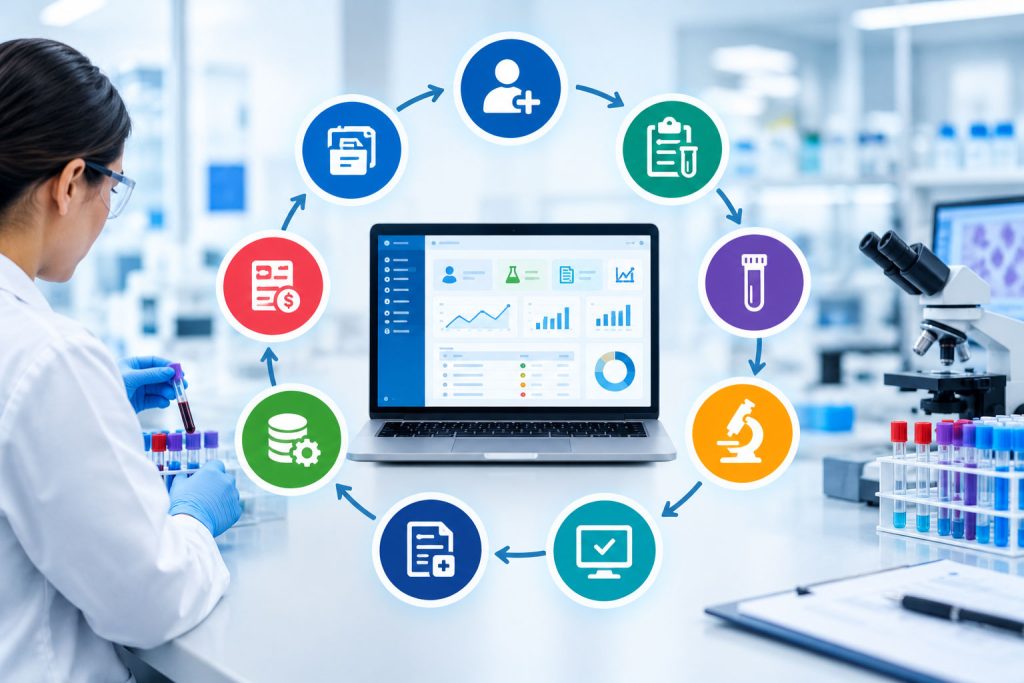
Patient Registration → Test Selection → Sample Collection → Sample Processing → Testing → Result Entry → Verification → Report Generation
Each stage produces information that can be stored within the system.
For instance, once a test is ordered, the system can associate that test with the patient’s record. When the sample is collected, its status can be updated. After testing, the laboratory technician can enter the result, and an authorized person can review or verify it before the report is released.
This creates a traceable digital workflow from registration to reporting.
The exact workflow varies between laboratories because a pathology laboratory, hospital laboratory, research facility, and diagnostic center may have different operational requirements.
What Makes a Modern Lab Management System Different?
Older laboratory software often focused primarily on storing patient information and generating reports. Modern laboratory management platforms are increasingly designed around the complete laboratory workflow.
A contemporary system may bring together patient management, test management, sample tracking, reporting, inventory, billing, user management, analytics, and integrations.
This broader approach is important because laboratory operations are interconnected.
For example, inventory is directly related to testing. Testing is related to samples. Samples are related to test orders. Test orders are related to patients. Billing may be related to those same orders.
When these areas operate independently, staff may have to enter information multiple times. When they are connected, information can flow between different parts of the laboratory.
Patient Management Is at the Center of Laboratory Operations
Every laboratory needs an efficient way to manage patient information.
A laboratory management system can maintain patient profiles containing relevant demographic and contact information, previous test records, orders, reports, and other data required by the organization.
One important advantage is easier access to historical information.
If a returning patient needs another test, staff can search for the existing patient record rather than creating a completely new record. Previous reports may also be available to authorized users, depending on the system configuration and privacy requirements.
This can save time and reduce duplicate records.
Managing Laboratory Tests More Efficiently
Laboratories can perform hundreds or even thousands of different tests depending on their specialization.
Maintaining a structured test catalog helps staff select the correct test when creating an order. The system can store information such as test names, categories, prices, sample requirements, reference ranges, and other relevant parameters.
This also makes it easier to update test information when laboratory requirements change.
Instead of maintaining test information across multiple documents, the laboratory can manage it from a centralized system.
Why Is Sample Tracking Important?
Sample management is one of the most important parts of laboratory operations.
A sample may move through several stages before a final report is produced. If the status of a sample is not properly recorded, staff may have difficulty determining whether it has been collected, received, processed, tested, or completed.
A Lab Management System can provide a digital record of the sample’s progress.
This can be particularly valuable in busy laboratories where many samples are being processed simultaneously.
Digital sample tracking can also make it easier for staff to identify pending work and follow up on delayed processes.
Faster and More Organized Laboratory Reporting
The final laboratory report is one of the most important outputs of the testing process.
Traditionally, preparing reports manually can involve repeated data entry and document preparation. A laboratory management system can use stored patient, test, and result information to generate reports according to predefined templates.
This can reduce repetitive work and help maintain consistency in report formatting.
Depending on the system, reports may also be made available digitally to authorized users, doctors, patients, or other stakeholders.
However, laboratories should configure report access according to their privacy, security, and regulatory requirements.
Laboratory Inventory Management Is Often Overlooked
Laboratory operations depend on many supplies, including reagents, test kits, tubes, containers, chemicals, gloves, and other consumables.
Running out of an essential item can disrupt laboratory operations.
This is why inventory management is an important part of modern laboratory software. A digital system can help laboratories monitor stock levels, record purchases, track consumption, and identify items that may require replenishment.
Where appropriate, systems can also record batch numbers and expiry information.
This gives laboratory management better visibility into the resources required to maintain daily operations.
Can a Lab Management System Improve Laboratory Efficiency?
Yes, one of the main purposes of laboratory management software is to improve operational efficiency by reducing unnecessary manual work.
Consider a simple example.
Without a digital system, a receptionist may record patient information on paper, a technician may receive a separate test request, an accountant may maintain another billing record, and the reporting staff may prepare the final report separately.
With an integrated system, these activities can be connected.
The same patient and test information can move through different stages of the workflow, reducing repetitive data entry and making information easier to retrieve.
The actual improvement depends on the laboratory’s workflow, software configuration, staff training, and implementation.
The Role of Automation in Modern Laboratories
Automation is becoming increasingly important in laboratory management.
Automation does not necessarily mean replacing laboratory professionals. Instead, it can reduce repetitive administrative tasks and allow staff to focus more on activities that require professional judgment.
For example, software can automate tasks such as report generation, billing calculations, notifications, inventory alerts, data organization, and routine administrative processes.
Advanced systems may also integrate with laboratory equipment and other healthcare systems where technically and operationally appropriate.
Can Artificial Intelligence Be Used in Lab Management Systems?
Artificial intelligence is becoming an emerging component of healthcare technology, including laboratory management.
AI-based features can potentially help analyze operational data, identify patterns, automate administrative activities, assist with information retrieval, and provide management insights.
For example, an AI assistant connected to a laboratory management system could help authorized users find information such as pending tests, inventory status, daily workload, or operational reports.
However, AI should be implemented carefully. Laboratory and patient information is sensitive, and AI-generated outputs should not automatically be treated as clinical decisions. Human oversight, appropriate access controls, validation, privacy protection, and regulatory compliance remain important.
The most useful role for AI in laboratory management may be to assist professionals rather than replace them.
What Should Laboratories Look for When Choosing a Lab Management System?
Choosing laboratory software should begin with the laboratory’s actual requirements.
A system should support the organization’s workflow rather than forcing staff to work around the software.
Important considerations include usability, patient management, test management, sample tracking, reporting, inventory, billing, user permissions, data security, scalability, integrations, backups, and technical support.
It is also important to consider future requirements.
A laboratory may start with a small number of users but eventually expand to multiple departments, branches, or locations. Selecting software that can grow with the organization can help avoid the need for a complete system replacement later.
What Is the Future of Laboratory Management?
The future of laboratory management is likely to become increasingly digital, connected, automated, and data-driven.
Cloud technologies can make information accessible across authorized locations. Data analytics can provide laboratory managers with insights into workload, turnaround times, inventory, revenue, and operational performance.
Integration with healthcare systems and laboratory equipment can further reduce information silos.
Artificial intelligence may also introduce new ways of interacting with laboratory data, particularly through intelligent search, automated administrative workflows, and decision-support tools.
At the same time, cybersecurity, privacy, data governance, and regulatory compliance will become increasingly important as laboratories store and exchange more digital information.
Frequently Asked Questions About Lab Management Systems
What is a Lab Management System?
A Lab Management System is software used to manage laboratory operations such as patient registration, test orders, sample tracking, test results, reports, inventory, billing, and administrative activities.
What are the main benefits of laboratory management software?
Laboratory management software can centralize information, reduce repetitive data entry, improve workflow visibility, simplify reporting, manage inventory, and make laboratory records easier to access.
Can a Lab Management System manage patient records?
Yes. A laboratory management system can maintain patient profiles, test history, orders, results, and reports according to the organization’s requirements and access policies.
Can laboratory software track samples?
Yes. Sample tracking functionality can record sample collection, processing, testing, and completion statuses, helping laboratory staff monitor samples throughout the workflow.
Can a Lab Management System manage inventory?
Yes. Many systems provide inventory features for managing reagents, consumables, test kits, purchases, stock levels, and expiry information.
Can AI be integrated into laboratory management software?
Yes. AI can be integrated for functions such as intelligent information retrieval, administrative automation, analytics, and workflow assistance. AI features should be implemented with appropriate security, validation, human oversight, and privacy controls.
A Lab Management System is more than software for storing laboratory records. It can serve as a central platform connecting patient management, test orders, samples, results, reporting, inventory, billing, and other laboratory processes.
As laboratories handle increasing amounts of information, digital management can help reduce repetitive administrative work and provide better visibility into daily operations.
The next generation of laboratory management will likely combine traditional laboratory workflows with automation, analytics, cloud technology, system integrations, and carefully implemented AI capabilities.
For laboratories considering digital transformation, the goal should be clear: create a connected environment where information moves efficiently from patient registration to testing and reporting, while maintaining appropriate security, accuracy, privacy, and human oversight.